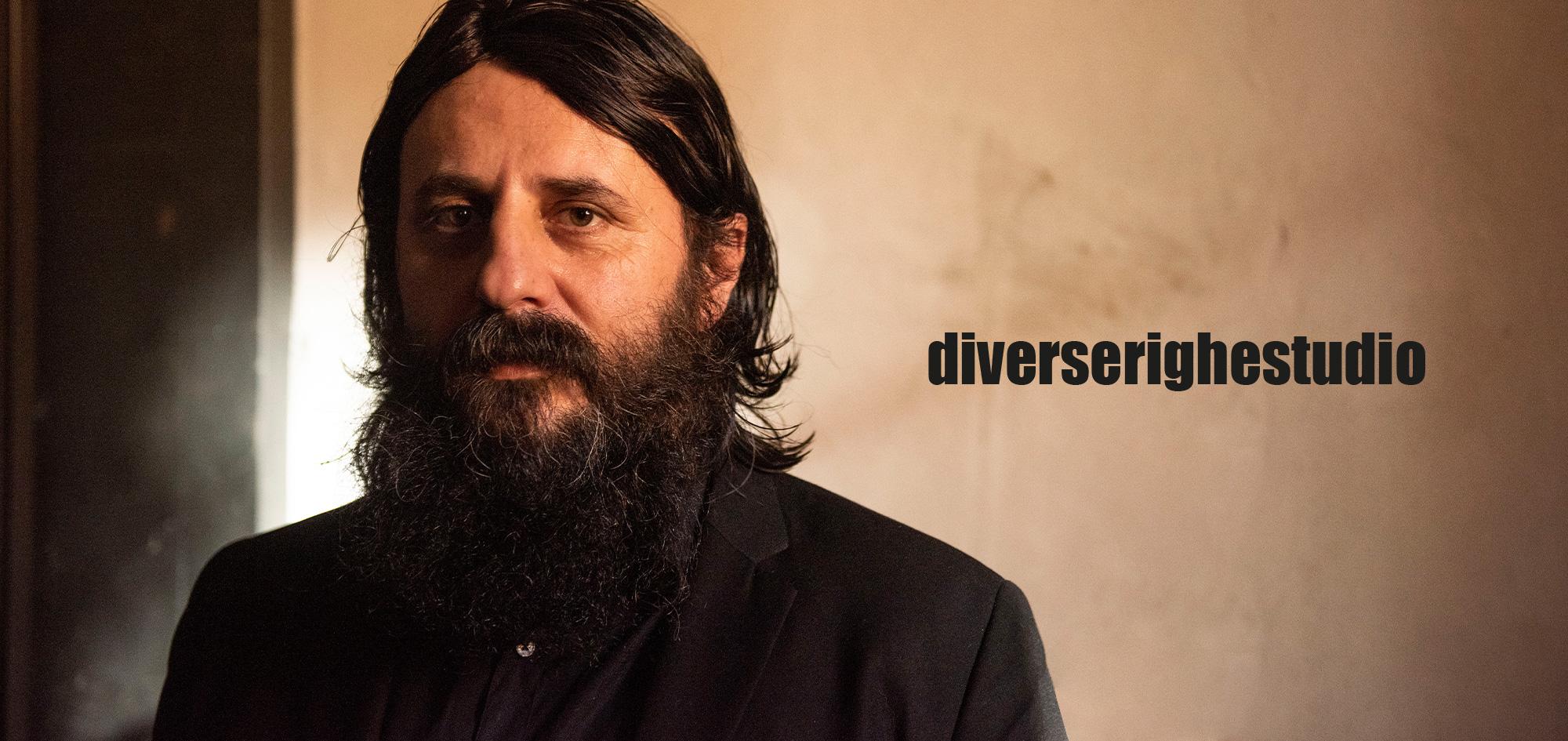
President of diverserighestudio and a member of the Public Art Commission, architect Simone Gheduzzi is above all an intellectual who forges connections between knowledge and artistic forms. Transforming them into architecture with one guiding conviction: the experience of space must allow to explore an elsewhere.
You are participating for the fourth time in the Venice Biennale of Architecture. What defines your architectural studio?
Also in the project Italia Infinita 2075, which you can visit at the Italian Pavilion curated by Guendalina Salimei, you will see that what sets us apart is the multidisciplinary research that precedes the design phase. We don’t just analyze a few case studies; we take the necessary time to explore the subject from lateral perspectives and in dialogue with the client.
This work—moving between memory and the future, bringing art and science back together—allows us to propose a holistic vision (as in the days of the quadrivium), in which the Client plays an active role rather than simply being a recipient of proposals.
We have always stood out for a certain predisposition—indeed, a real need—to engage with other disciplines, other perspectives beyond architecture. To quote Carmelo Bene, whom I admire deeply as an artist: “You cannot make architecture from architecture”—just as you cannot make dance from dance, or music from music. That is the critic’s work. Our work, as creators, is to remain attentive, able to sense forces, interpret them, and give them form. After all, as Paul Klee once said: “Art does not reproduce the visible; rather, it makes visible what is not always so.”
This way of being requires a profound attentiveness to the reality around us; it becomes a way of life. One must be a work of art in order to create an artwork. That is the condition that distinguishes truly gifted creators from those who, though diligent and determined, spend their lives striving to resemble the former while in fact leading a more conventional existence.
Who are your typical clients?
The research carried out by our studio has attracted clients who are in tune with our spirit. Today, much of our work is for philanthropic foundations that use architecture as a means of communicating their benevolent aims.
These foundations believe that architecture is a tool for education, capable of creating identity within spaces and of giving back to the people who inhabit them a higher quality of life. This is not limited to the cultural sphere—as in the case of Fondazione Golinelli in Bologna, with whom we have been collaborating since 2013.
At present, for instance, we are working at the Policlinico Sant’Orsola hospital for the Fondazione Policlinico Sant’Orsola, which has adopted the payoff “the healing space” in the projects we are developing together. Scientific evidence shows, in fact, that patients respond better to therapies when they are in environments that strive for beauty and open up the imagination.
What role does art play in this?
It’s a very broad subject, because architecture is both an artistic and a scientific discipline, yet it has a unique trait: architecture hosts all the other arts. Since classical times, architecture has been conceived together with works of art, which were not mere additions but—using a parallel with rhetoric—sometimes its grammatical and syntactical structure, and always its figurae, its punctuation. When we imagine a space, we envision it with this idea of a profound relationship between architecture and art.
To explore this even further, I also opened a gallery within an architectural context, called PIETRO, where I live alongside people who create works of art, and where I continue a path that began earlier with another cultural association called lasantabarbara. I involved many professionals and artists who took part in the “operation of meaning” that precedes form in the context of specific projects.
What do you think of Cinquerosso Arte?
When I first came across Cinquerosso Arte, I saw it as a great opportunity for young artists. In our country, it is far from easy for an artist to find a position from which to fully develop their potential. Cinquerosso Arte allows these artists to express themselves not only through exhibitions, but also by providing the opportunity to sell their works and be part of a tangible creative network. For the youngest artists, it can even be the first step into the professional world—and therefore into artistic expression—laying the foundation for a career.