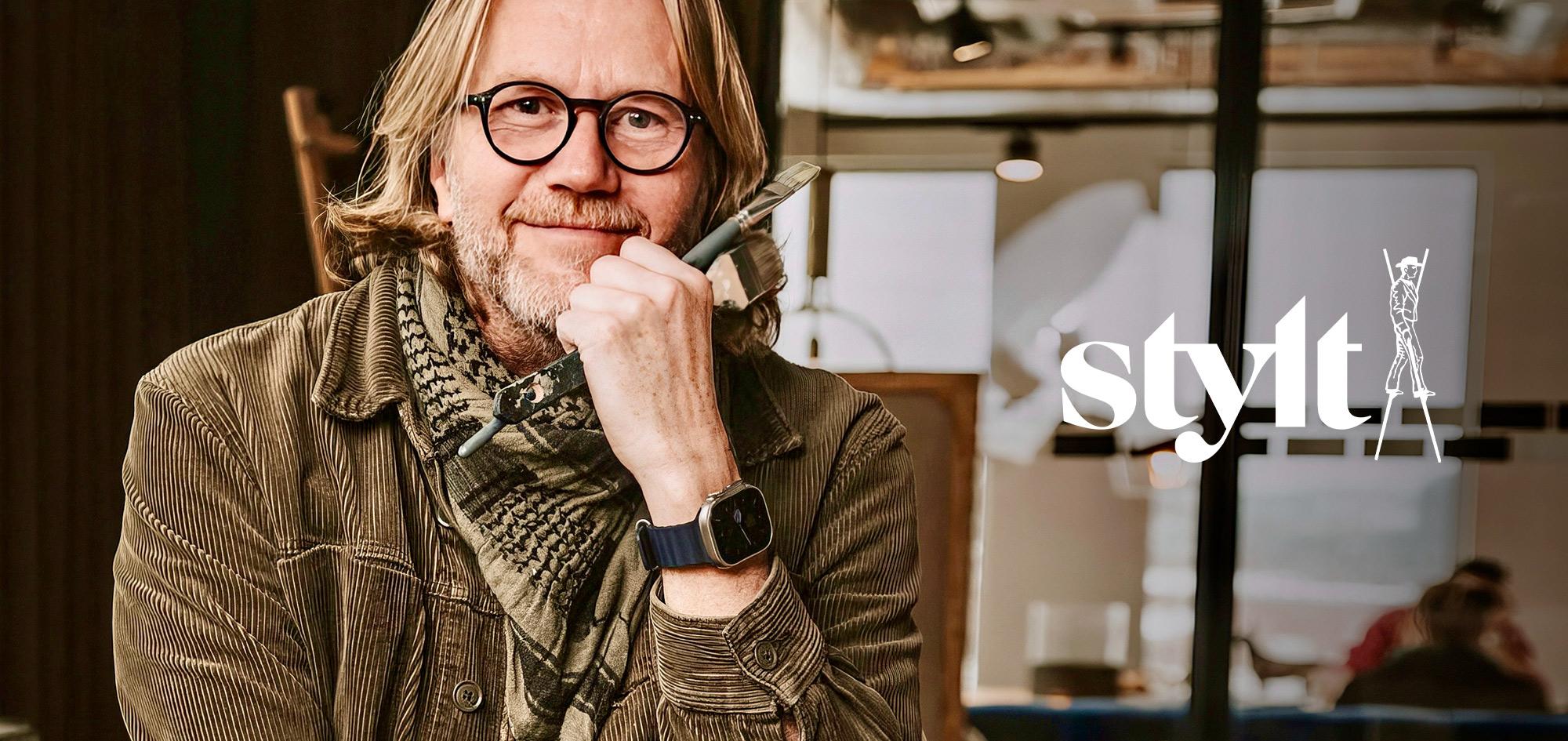
Erik Nissen Johansen, founder and creative director of Stylt Trampoli AB, leads one of the most innovative design and storytelling studios in the global hospitality industry. Inspired by the Renaissance in Florence, he brings together diverse perspectives—storytelling, art, and a deep understanding of hospitality—through a multidisciplinary approach that sets his projects apart.
Erik, let’s start from the beginning: what’s your story, and what vision has inspired your professional journey?
It all started in high school A teacher introduced me to the Renaissance and Florence, sparking an inspiration that made me know I wanted to go there.
I moved to Florence to study art, creative design at the Istituto per l’Arte e il Restauro and there I met a Swedish couple. We decided to create a new kind of consultancy firm: producing our own art, exhibiting the art of others, running a gallery, and working in design and marketing. The idea was to bring different expertise together, like they did in the Renaissance.
So we did it, and I moved to Göteborg to form this group. We had a Manifesto saying: “Everybody may paint on everybody’s painting, and nobody is allowed to be angry about it.”
It was hard sometimes, and the results were never exactly what I had intended, but it was always interesting… it was different! Which I think is the real currency of today’s experience economy.
We did that for three years, five artists, and we had a lot of friends in the restaurant business. We helped them design interiors for restaurants, invite the right people to opening parties, come up with the name, the concept and the storytelling.
Then we split up, and I really fell in love with hospitality… I loved the process of shaping experiences together with the restaurateurs —it made me want to start a business involved in hospitality projects with an artistic and storytelling approach, as it had worked well before.
So, my vision is indeed heavily influenced by the history of the Renaissance, Florence, Italy, and art. It took a few years, but today it’s a successful business with a very artistic narrative. The artistic approach is very, very important—it’s part of our consciousness because of our heritage.
What does ‘Stylt Trampoli AB’ mean, and how did the idea of blending disciplines come about?
The name “Trampoli” is Italian—it means walking sticks. Back in Florence, I was taking an Art History class with Peter, one of the Swedish artists I started the collective with. There was once this lecturer who had noticed us in the café downstairs, rather than attending her class, and shouted: “Trampoli, venite qui subito!”. She nicknamed us the “stilt people” because we were the tallest in the class. The nickname stuck. Stylt represents a simple tool to gain a different perspective.
The idea of crossbreeding different types of knowledge comes from the Medici family in Florence. They gathered poets, painters, architects, and engineers; working together, they made each other better. That same principle is what Frans Johansson describes in The Medici Effect: breakthroughs happen when people from very different backgrounds meet. When you are open to new perspectives.
In our company, we follow that approach. We like to think that our creative group isn’t just us. Even though our team includes marketing people, graphic designers, copywriters, storytellers, interior architects, architects, and artists, we also involve chefs, owners, and investors in the creative process.
We know that the most innovative ideas are democratic — you don’t need years of education or experience. That’s why we include interns and young people in the creative process, and often the freshest and most groundbreaking ideas come from them.
Look at innovative hotels like Ace Hotels—they weren’t created by Marriott, but by three DJs. A DJ knows how to make a room feel right, a corporation knows how to make money. Both perspectives are crucial, but if the room doesn’t feel good, it’s hard to succeed. That’s the reason why blending disciplines and experiences is central to everything we do.
Looking back on your journey, what key moments do you think led Stylt to international success?
Several milestones shaped our journey.
One was the Stenungsbaden Yacht Club project in Sweden—a large conference resort that had a reputation for hosting wild weekends. It needed a complete makeover.
We transformed a Villa on the property into a twelve-room boutique hotel called Villa JC Stevens, themed around the America’s Cup. That project allowed us to follow our vision 100%.
And for the first time, we won the AHEAD Awards in London, beating the most famous architecture firm with our project. Another landmark was our work on Klaus K in Finland, which became part of Design Hotels™ and received outstanding reviews worldwide.
I also have to mention the third one: the Sonya Hotel in St. Petersburg. When we first arrived in St. Petersburg, we noticed two things: most hotels tried to imitate American chains, and the city itself is truly Russia’s cultural capital. Peter the Great built museums, opera houses, and institutions with that vision. So, we took Dostoevskij’s Crime and Punishment, the city’s most famous novel, and translated it into a hotel experience. It made perfect sense, and it became famous in Russia overnight, and received reviews from around the world. After that, international attention followed, though, in a way, the most important project is always the latest one. That’s what continues to get attention.
How important is storytelling in the hospitality sector, and what role does it play in your projects?
Humans are a storytelling species—we’ve been sharing information through stories long before writing existed. It’s an underestimated but powerful tool, especially in marketing. When you open a hotel, you need people to know about it, and stories are the fastest, most natural way to engage and inform. For us, storytelling drives the entire design process.
First, we identify a hotel concept that makes sense—what’s missing in the market or what could succeed in that city. Then we create a compelling narrative, which shapes design, marketing, and guest experience. The story must be strong enough to make communication effective.
Hotel Sonya in St. Petersburg is a perfect example. About a month before its official opening, the hotel quietly launched one of its two converted apartment buildings. Soon after, the mayor, Ivanovna Matviyenko, unexpectedly showed up the next day with the press to celebrate the hotel, highlighting it as a cultural landmark and a point of pride for the city. Through this story, and approach, the hotel became widely known around the city before its official launch.
This is the power of storytelling, although it wasn’t an easy story to choose. By doing so, the hotel stood out from the prevalence of American-style hotels, and it has been called the most accurate portrait of St. Petersburg ever written. A 150-year-old murder involving a student and an heiress.
Though dark, the story reflects St. Petersburg’s character: the tension in the city, the contrast between good and evil, renovated versus decaying buildings, luxury alongside dilapidation. I really think that following that path in that case gave the hotel authenticity. Traditional marketing would have been far more expensive, but a storytelling approach created impact, authenticity, and resonance that conventional campaigns could simply not achieve.
What challenges do you foresee for the future of the hospitality sector?
One key challenge, which is also an opportunity, for the future of hospitality is the rise of AI in travel planning. In the past, tailor-made trips were accessible only to the very wealthy, with personal agents arranging every detail. Now, AI is making highly personalised travel experiences available to a much broader market. This shift opens the door to more diverse and niche hotels designed for specific target audiences rather than the general public.
The challenge lies in educating clients to appreciate these unique experiences. A standard hotel in a convenient location will perform predictably, but a hotel that dares to offer a highly curated experience can achieve much higher revenue. Even a modest increase in room rates can translate into significant gains. As AI enables increasingly individualised travel experiences, the hospitality sector faces both the promise of innovation and the challenge of meeting evolving expectations.
What role does art play in your work, and what do you think of Cinquerosso Arte?
Art is obviously a huge deal. We started as an art collective with a manifesto promoting collaboration and inclusion. In a new hotel, about 80% of the budget goes into construction, the rest into design, paint, furniture, and work, while the art layer may represent only half a percent of the total budget—sometimes even less.
But art can represent up to 80% of a hotel’s impact and is a key differentiating factor from competitors. It gives the space personality and conveys the presence of a caring host, even when they are not physically present, which is a major advantage because it allows the experience to scale. For me, this is by far the most important part of the process, although my background may make me a bit biased.
Cinquerosso Arte plays a very important role by helping us source high-level, authentic artists, which is very important for our work.In the past, hospitality design often relied on safe, neutral choices, including in art, to avoid overwhelming anyone. Staying in a hotel allows guests to experience a world they wouldn’t normally encounter—a style or design they might dream of having at home, but can fully explore in this unique environment. To truly unlock a hotel’s artistic potential, there needs to be an emotional narrative, and the art should convey that story, giving it impact. The services Cinquerosso Arte provides for hospitality projects are therefore very important for our work.