Alberto Apostoli needs no introduction. A global leader in spa design, his Studio Apostoli, is highly renowned in the world of hôtellerie. It is, therefore, a great honor and privilege to have the opportunity to speak with him about wellness architecture and the role of art.
Architect, the philosophy that inspires your projects is the combination of architecture and wellness. Can you describe it for our readers?
The design philosophy I have always pursued views architecture as a tool—a means to create well-being rather than an end in itself. Beyond the aesthetic impact that architecture has on people, I never stop at mere formal or architectural exercise.
I always try to imagine what the benefit for people will be in a certain architectural choice, a particular use of colour and shapes, a determined size of space.
I think about what the functions will be, the relationship between interior and exterior, and every other detail. I consider all this in the perspective of the impact it will have on mind, body and soul.
Exploring the best solutions for human well-being represents a significant shift in the design paradigm: the aesthetic effect, artistic gesture, or technical execution—essentially the formal aspects—are all subordinate to the pursuit of wellness. It’s not always easy, but the payoff of my studio is precisely “Creator of wellness through architecture”.
What are the challenges that an architect has to face in this field, and how is this different from others?
In wellness architecture, we must take into account both the end customer and the staff, as well as the sensory quality of the spaces. This means engaging all five senses: sight, of course, but also smell, touch, hearing, and, to some extent, taste.
And then there’s the quintessence, that sort of sixth sense that emerges when particularly emotionally charged situations occur. This is a key aspect when considering our work from a poetic or artistic perspective.
There are also inherent challenges in the wellness sector, such as the technical demands of systems and installations. Additionally, we must evaluate the stress placed on materials and surfaces—think about the temperatures involved, the use of water, and the humidity in these environments.
Another critical factor is the experience of customers who will be moving around half-naked, barefoot, or unable to wear glasses, which reduces their visual acuity.
As a result, we must apply very specific technical considerations that differ greatly from those required in other types of architecture.
Last but not least, one needs to know the wellness machine very well; that is, one needs a full awareness of how spaces are used, managed and maintained. The wellness experience is not only dependent on architecture, but also on service, particularly in terms of comfort.
This means being able to predict and assess how the staff will move, how the customer will move: a characteristic that the world of wellness has in common with that of catering. We cannot design something beautiful if it is not functional.
You also deal with product design. So, in addition to the spaces, you also design what these spaces contain…
Yes. Designing products means having to take into account everything I mentioned in terms of functionality, but for us it also means giving importance to multisensoriality. The products we design usually speak not only to sight but also to the other senses, and in this we are very attentive to the technological component.
Furthermore, in the vast majority of cases we have to consider a certain rituality, a certain liturgy of the object. It’s an aspect that fascinates me a lot, and it’s really specific to the world of wellness.
If we think, for example, of a massage, a sauna, a certain use of water, we notice a rituality that in some cases becomes a sort of liturgy: a recurring and normalised rituality. Let us bear in mind that the world of wellness is often linked to practices and philosophies of oriental origin, and bears traces of them.
The main effect of these liturgies is to bring order to actions: if one does not have to ask oneself what to do, it is easier to concentrate on the hic et nunc.
Obviously we have to take into account the market, available technologies, ergonomics, but as I said, we give great importance to the liturgical aspect.
What is the role of art in all this?
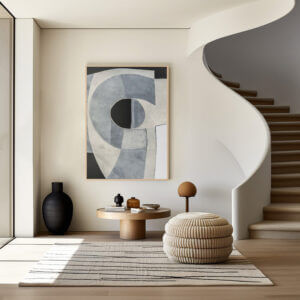
In the wellness world, art comes in all its forms, from painting to music, but the use of light, or cooking, is also an art. Figurative art in particular is fundamental because it emphasises or interprets the overall concept. If we think of the hospitality sector, the storytelling of a hotel also passes through the works of art included in the architectural work, which have the power to charge, concentrate, synthesise a thought.
The average customer cannot fully understand a storytelling as complex as that of a hotel, but can perceive its essence with a simple image.
This is also, and especially, true in the wellness sector. To give an example: in the case of a cabin, I have to choose different artwork depending on whether a Nordic or Thai ritual is practised, in order to communicate effectively and create the right atmosphere.
What do you think about Cinquerosso Arte, and the idea of a gallery dedicated mainly to hötellerie?
The idea of Cinquerosso Arte is absolutely in line with the needs of this sector, because it offers a very interesting variety and complexity of artistic proposals. Those who, like us, find themselves having to emphasise complex concepts, need a vast catalogue and lots of stimuli. In some extreme cases, one might start from the very work of art and build a concept around it. Cinquerosso Arte proposes very different artists, each with their own style and interpretation, and it could be interesting to commission works based on certain project specifications.
It happened to us to do this, that is, to turn to artists with a similar sensitivity to the concept and ask them to interpret it, to be inspired by it. It is a commissioned work, but this does not detract from the artistic value: just think of the Sistine Chapel, which is a striking example of what can be created from a commission.
My studio always gives the client indications, if not prescriptions, regarding the decorative aspect, and this also includes the choice of artwork.
In fact, one has to consider that personal taste plays a big role in this type of choice, but it can happen that the tastes of the owner are at the expense of the end result, regardless of the quality of the artwork itself.
A marvellous work of art can spoil a storytelling with which it is not in tune, which is why it is necessary to go beyond personal taste and make an informed choice, especially in the hötellerie sector.