by Christian Conovalu – DiLei.it
With Cinquerosso Arte, contemporary art becomes part of interior design projects, engaging with lived-in spaces and transforming every home into a visual story.
No longer confined to galleries and museums, art today becomes part of interior design projects, intertwining with materials, colors, and lighting to transform every space into a story. This is the vision of Cinquerosso Arte, a platform founded in Bologna in 2022 by Francesca Fazioli, with the aim of promoting emerging artists and making art accessible by integrating it into everyday spaces.
In this interview, they guide us through intuition, planning, and poetry, showing how art can truly become the soul of a space.
Art that lives within spaces: beyond aesthetics

Instead of displaying art in a static way, you bring it into homes and lived-in spaces. When did you realize that emerging art could become an active part of interior design, and not just an aesthetic complement?
Cinquerosso Arte was born from the desire to spread beauty, to bring it into everyone’s homes and not just collectors’. This means helping young talents on one hand, and on the other offering beautiful and interesting works at affordable prices. The association with interior design was almost immediate because we believe that a harmonious and well-thought-out environment enhances the artwork, and the artwork, in turn, can add emotions to the environment. This applies to any context: a home, a hotel, an office, or any other lived-in space.
Moreover, a well-executed interior design project should always include or at least consider artworks, but this is not always compatible with the costs of already established pieces. That’s why the association between interior design and emerging artists is so interesting.
Emotion and language: poetry at the center
You select works by emerging artists with a very precise and contemporary eye. What do you really look for in a work? Is the visual language more important or the ability to evoke a narrative within the space?
Certainly, the evocative ability is an aspect we consider very carefully because it is fundamental to arousing emotions. Whether it is a true narrative or a particular combination of colors and shapes, the artwork must generate sensations and perhaps trigger reflections.
In selecting artists, we also prioritize those who have their own poetic vision: a concept, a project, a distinctive language. Only in this way we can offer original works with a true “personality.”
The artwork that transforms: a concrete example

Can you tell us about a project where art radically transformed how a space is perceived? One of those cases where the artwork interacted so well with the environment that it almost became its soul?
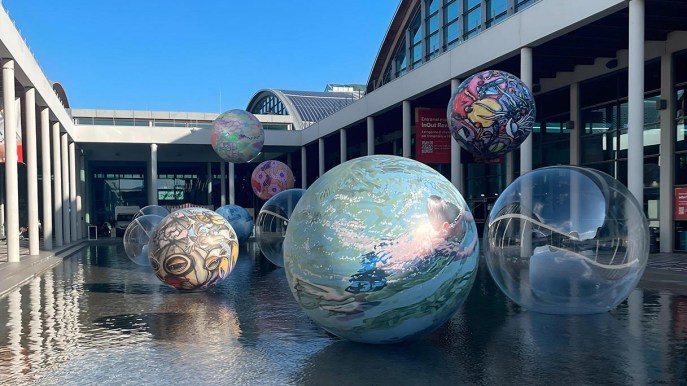
Perhaps the best example is the installation of the pool area at the Rimini Fair for InOut 2024. In this case, the artworks were more than just decorative elements—they completely transformed the space by adding new dimensions, shifting perspectives, and redefining its meaning. We printed the artworks on spherical surfaces to align with the event’s concept, which centered around the theme of truth.
As a result, the pool area was no longer merely a passageway but became a key part of the fair experience.
Between intuition and planning
In your work, how much is guided by intuition versus strategic planning? Does the artwork inspire the space, or does the space inspire the artwork?
Usually, the design of the space drives the choice of artwork. The interior designer starts with a clear concept and looks for pieces that will complement that vision. We provide specialized consulting to help identify the perfect artwork.
A great example is the Hotel U-Visionary in Venice: the design concept focused on Venice as a bridge between East and West. Everything followed this theme—materials, fabrics, furnishings—and the selected artworks reflected this atmosphere perfectly.

Living, approachable art
Art can be intimidating, especially in home settings. What’s your approach to making art feel alive, accessible, and deeply integrated—not like something from a museum, but truly livable?
As we mentioned, the works we offer are always connected to the artist’s personality and reflections. We collaborate with over fifty artists, so we can provide a wide selection where it’s easy to find something that resonates with the client’s sensibility.
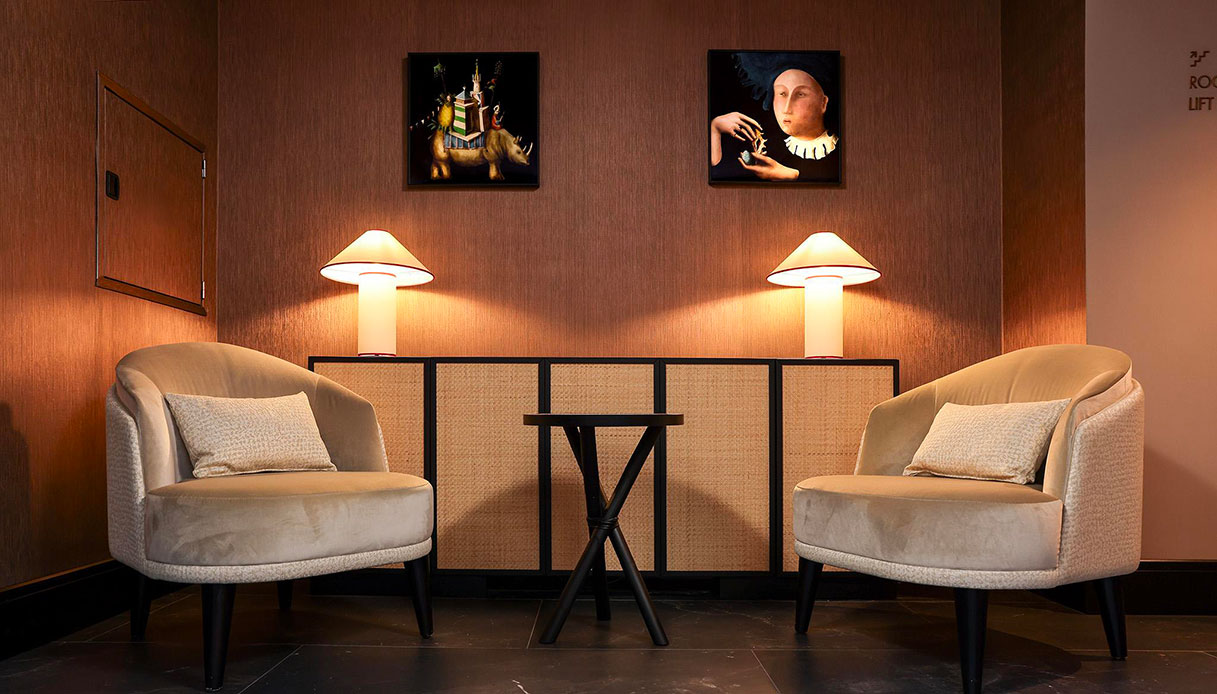
When selecting artists, we also consider the “readability” of their works: they’re never meant to shock or disturb. We favor poetic, dreamlike, reflective languages—sometimes ironic or unexpected, but never too aggressive.
For us, art is something that should authentically inhabit a space, not overpower it.
Where to start
For those furnishing their home who want to bring in art in an authentic way, what’s the first step? How do you avoid both the decorative effect and that of a “forced collector”?
The decorative effect is almost inevitable if you choose works lacking originality—like those you find identical in large stores. It’s better to look for something original: at flea markets, emerging artists’ exhibitions, or—of course—on our website.
Those working with a designer might worry about feeling detached if they’re not involved in selecting the artworks, but that’s actually a rare risk. Designers know how to interpret the client’s sensibility and create a tailored project.
This is where we come in: as consultants who work directly with the client but have a clear vision of the overall design project.
And this is what sets us apart from traditional galleries: we don’t sell works just for their intrinsic value, but consider them in relation to the spaces where they will live.