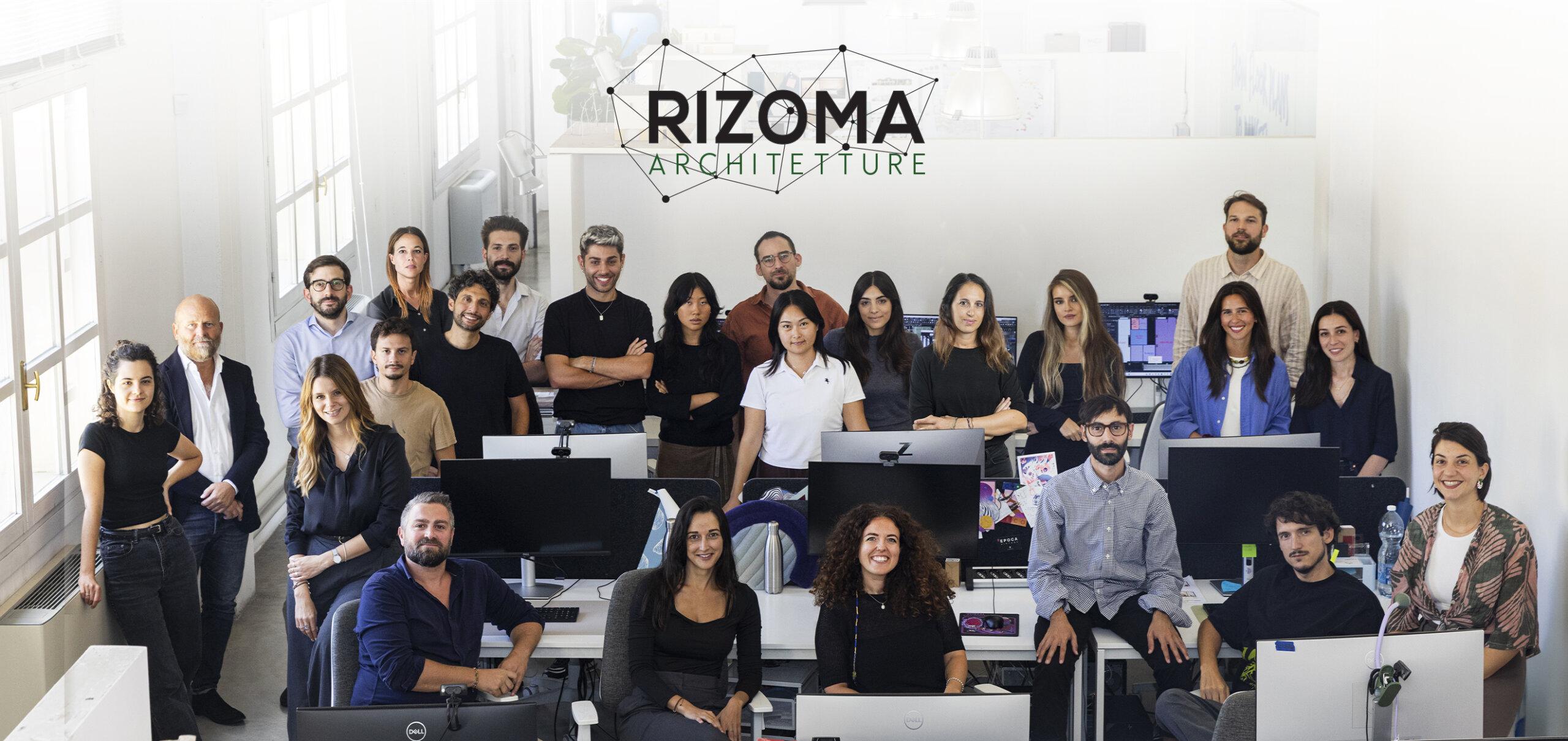
At his studio, Rizoma Architetture, Giovanni Franceschelli shapes spaces around people and their needs. These are living environments where social interaction takes center stage and in this approach, art naturally finds its place.
Can you tell us about your academic and professional background as an architect?
My education is divided between my university experience in Italy and a key period spent in Barcelona, where I attended a master’s program at the Polytechnic University of Catalonia.
It was a very intense two years, enriched by work and research experiences that deeply shaped me. When I decided to return to Italy, I felt a strong urge to bring everything I had learned in the Catalan context into a city like Bologna—different, yet with many resonances.
Right from the beginning, my interest focused on public spaces, places of socialization and living. The university had also given me an international outlook, looking towards Europe and beyond.
Today, almost 25 years later, that vision is an integral part of the DNA of Rizoma Architetture: a studio with 32 professionals, two offices—Bologna and Milan—and a team composed of nine different nationalities. With a very young average age and a strongly international spirit.
What are the typical projects your studio works on?
For nearly 25 years we have been pursuing research on the spaces of living. Which over the past decade has translated into numerous hospitality and shared housing projects. We were among the first to develop a cohousing project in Italy, specifically in the Emilia-Romagna region.
Today, our work explores different forms of living: from student housing for very young residents to senior living designed for people over 60. The common thread is always residential comfort and the quality of shared spaces, because we strongly believe in the value of social interaction.
We describe our approach as “design for people”, as our work is based on open and flexible visions that change each time according to the community that will inhabit the space. In other words, our projects are not defined by a recognizable style or a replicable formula, because every living environment is different.
What role does art play in your projects?
Over the past ten years, we have almost always involved artists in our hospitality and student housing projects. Collaborating with local realities or promoting open calls at an international level.
This has happened in Florence, Milan, Rome and Turin. In Turin, for example, we worked on a student residence in the San Salvario neighbourhood, choosing to describe the context through an artistic narrative capable of addressing the critical issues of the area. A sort of fairy tale that could help improve the perception of a neighbourhood that was very problematic at the time.
For us, art – especially urban and contemporary art – is an “extra layer” that integrates with architecture and interior design. It is not decoration, but a tool for telling the story of the city and offering people a different perspective on the many transformations taking place.
In this sense, art becomes both a space for reflection and an identity-defining element of the project, an exhibition open to the city. Speaking not only to those who inhabit the space but also to everyone who moves around it.
How did you come to know Cinquerosso Arte, and what do you think about the idea of making art accessible for hospitality?
I met Cinquerosso Arte at events related to the world of architecture, design and art. We immediately felt a great connection. I strongly believe in making art accessible in social spaces such as hotels, but also in student residences, which are mainly frequented by younger generations who are exposed to creative influences on a daily basis. Integrating architecture, art and interior design is a natural choice for me, consistent with my personal and professional journey. I am very happy about this collaboration and very confident that this will generate projects that combine design quality and cultural value.