An exhibition by Cinquerosso Arte
Opening on 13 November and running until the end of January, “Human, All Too Human” will be presented at Cinquerosso Arte, located at Palazzo Guidotti, Via Farini 9, Bologna.
Curated by Camilla Barbone, the exhibition brings together artists Giuseppe Barilaro and Filippo Manfroni for the first time. Two artistic journeys, two philosophies and two distinctly different styles converge around a shared and inexhaustible subject: the human figure.
The exhibition’s title, borrowed from Nietzsche, evokes an exploration into the very nature of human existence: what is our life made of, and what makes us who we are? Are we defined by our actions, or by something that transcends us? Where do we come from? What does it mean to exist, and what remains of us as time transforms our bodies and memories?
These are questions that have accompanied humanity throughout its history, spanning religion, philosophy and art. Body, time and identity thus become the guiding coordinates. Through which to seek answers, exploring the artistic journeys and pictorial languages of the two artists.
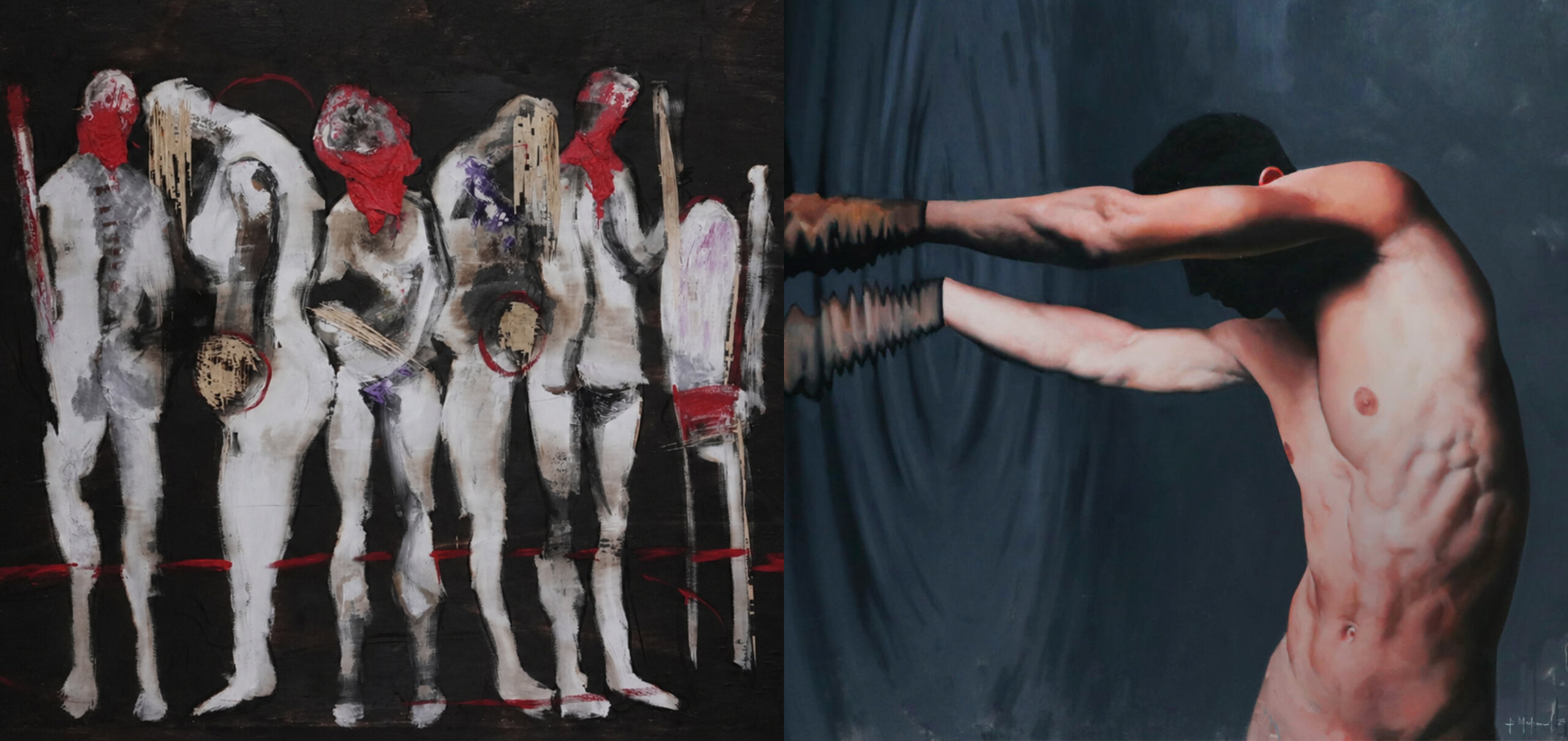
For Giuseppe Barilaro, the human figure is a starting point from which to embark on a gradual loss of recognisability. The face, the body and the image itself undergo a destructive process until their identity can no longer be deciphered. The surface is scratched, engraved, burned and torn. Yet it is precisely through this act of subtraction that painting seems to discover a new possibility. When a face can no longer be identified, what remains is not emptiness, but a more universal truth that speaks to humanity as a whole. What also remains is the artist’s gesture, itself a trace of the human presence and its actions.
The gesture is not merely a technical means; it becomes the very subject of the artwork. The artist builds, then intervenes upon what has been created, dismantling and transforming it. Creation and destruction thus cease to be opposing forces and become successive moments of the same process. The material retains the marks of what it has endured, like skin bearing the scars left by time. This is a form of painting that does not conceal its own making; on the contrary, it reveals the very actions through which it comes into being.
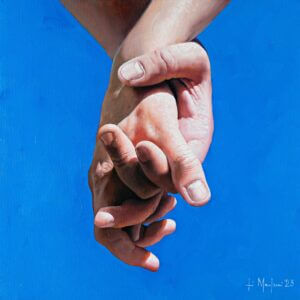
In Filippo Manfroni’s work, the body takes on a more sensual and perceptual dimension, poised between presence and dissolution. Colour may define its contours, but also spill beyond them; light may reveal while simultaneously softening its forms. Although his figures are fully recognisable, often even hyperrealistic, they are never mere representations, but rather the subjects of profound narratives. The body becomes the surface upon which the artist writes the story of human existence, with its emotions, contradictions, beauty and fragility, through a visual language of colours, light, shapes and planes.
The human figure thus becomes a metaphor for experiences shared by every individual: passions, relationships, fears and desires. In Manfroni’s work, we encounter both the mal de vivre and the wonder of existence. His paintings are always born of curiosity, shaped by a sense of wonder that is renewed with every encounter with the other, and ultimately lead to a feeling of gratitude for the extraordinary privilege of being alive.
Human, All Too Human brings these two very different approaches into direct dialogue, revealing a shared intention: to give form to a complexity shaped by profound contradictions and infinite nuances. Painting thus becomes a means of understanding that reaches beyond the limits of reason: a way of knowing that is also a process of recognising ourselves, both in our individual identity and in the universal human experience that connects us all.