Sign up for our newsletter and receive a 10% off
Send a gift card to your loved ones!
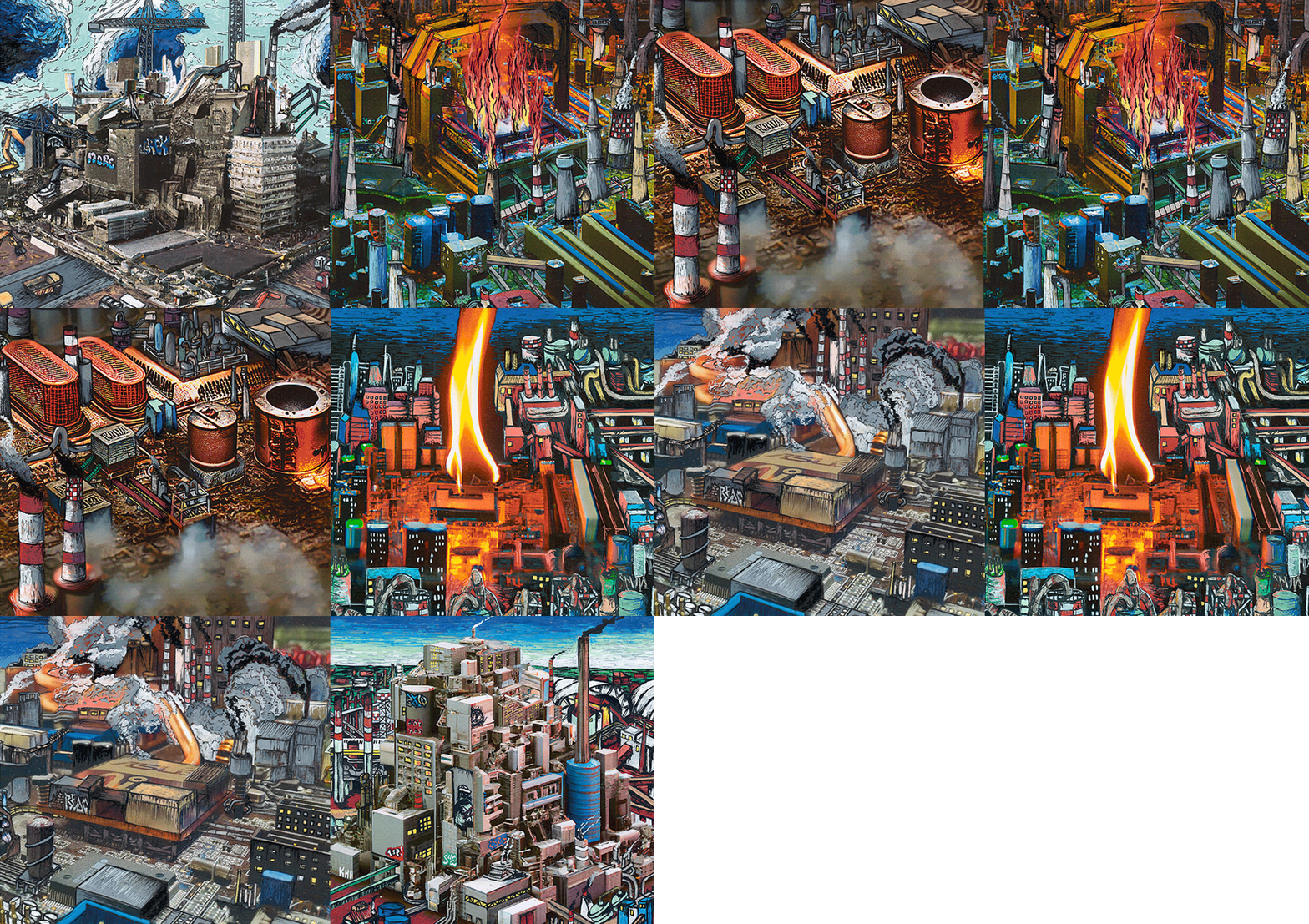
paesaggio industriale

Alessio Privitera – The wonders of perception

A psychologist and lover of urban and industrial landscapes, Alessio Privitera plays with shapes and dimensions to entice the eye. Nothing is what it seems, and this requires the viewer to participate in the communicative process that the work initiates.

Alessio, tell us about you.

I have a degree in psychology and have always had an interest in art, partly because I have an uncle who is a painter, specialising in landscapes, and my father is a professor of technical drawing. Through my studies, I became very interested in perception and had the opportunity to collaborate with Gabriele Devecchi, an artist and designer who worked a lot on this aspect. Together with him I made an Ames room, that is, an environment whose perspective lines mislead the eye to such an extent that two people placed at the corners appear to be very different sizes, even though they are actually the same.I was very fascinated by the theme of perception, and from there I started to develop my own style by combining it with another of my passions, urban exploration. Basically, I like to go around cities in search of abandoned factories, smokestacks, refineries, steel mills, orphaned metropolitan environments.

What fascinates you about these landscapes?

I like them from an aesthetic point of view, because they are full of details; they are pictures in themselves, even though they are actually ecomonsters, because they are cumbersome structures that disfigure the nature around them. I was particularly impressed during a trip to Japan, where I noticed how – for example – the sea is not seen for its beauty but only as a working tool, and consequently there is no attention paid to preserving it. Despite this, the abandoned industrial landscapes are extremely interesting to me. Steel mills and blast furnaces, above all, fascinate me because of their great wealth of detail. At night, when they are illuminated, they are very impressive.

And how do cityscapes and optical illusions combine?

They combine through another passion of mine, that for microchips. I see and have always seen industrial environments in these circuits. So here I take macro photos of motherboards, and then I draw refineries or industries on them. Perception is tricked, because whoever looks at my works sees very large environments, while the source material is tiny. I was very inspired by Mario Sironi, by Lowry, by Diego Rivera, trying to develop my own style. It took time, and so far I have never set myself the goal of selling my works. Today I feel quite satisfied and I am starting to come out of the closet, but my aim remains to instil curiosity and make the viewer active, not passive.I like to think that a person, passing by one of my works, stops to look at it, asks questions. I like the idea that it is not a one-way communication from the artist, because the viewer sees, interprets, formulates questions and answers.

What do you think of Cinquerosso Arte?

was really impressed by the fine art print. I saw the prints live and I did not expect such an accurate rendering of the original: you can even see the tears, the marks on the canvas. Really incredible. In my case, it is interesting because it allows me to change the size of my works, which in the original are at most 20 or 30 cm per side, and make them much larger, without losing any detail.

Read the article of the artistic installation for InOut 2024!

Alessandra Scandella – I Let the unpredictable happen

As an artist and teacher, Alessandra Scandella seeks the unexpected that characterizes all living things in her works. She loves watercolors for this reason; their materiality, mutability, and expressiveness allow them to tell every kind of story.

Alessandra, what has been your educational background?

While attending university, I studied illustration at the Scuola Superiore di Arte Applicata del Castello Sforzesco in Milan. I began working in advertising right away, but I was always in search of my own style—one that represented me and that I enjoyed. This led me to focus on watercolors and inks, and I have consistently used these techniques ever since because I want to start from a place of craftsmanship. I love the unpredictable nature of ink blots, and I believe this makes a difference, especially in an era of artificial intelligence and digital processing. I have no aversion to these tools, but they need to be used judiciously. This is one of the topics I cover in my courses.

So you also became a teacher…

Yes, I teach at IED and the International School of Comics in Milan, where I specialize in watercolor and ink. I thoroughly enjoy working with young people, guiding them through a journey that starts with mastering the technique and culminates in a final project, always preserving an element of craftsmanship and manual skill. One example I often use is that of the portrait: you can start with the same subject and paint it ten times, and you will always get ten different results.

Could you describe your techniques for us?

As I mentioned, I love watercolor because it allows me to express my style with its unpredictability. I use a lot of intense and concentrated colors like reds, oranges, purples, and golds, applying them with minimal water for bold, solid areas, and contrast them with very delicate, transparent washes. I’m not fond of faded watercolor; I prefer it concentrated as it gives more energy to the artwork. I also always leave white spaces, as I believe that white highlights the color and drawing, enhancing the details. Another aspect I appreciate about watercolor is that, unlike acrylics and other techniques, it always leaves something unresolved—much like in some poetry, where the unspoken holds meaning. I often tell my students not to be afraid of using water, allowing it to create spots that tell stories. I encourage them to “dive into” these spots and draw from them.

In which fields do you work?

In addition to advertising, I work extensively in interior design, particularly in creating wallpaper. I also collaborate with the fashion and beauty industries. These fields allow me to express my style and apply my techniques in ways that resonate with me. I also participate in exhibitions, which I greatly enjoy because it gives me the chance to display original artwork.

My work for clients begins with manual execution—drawing, sketching, inking, watercolor, and stains—and then moves to a digital phase with high-resolution scans. This process allows me to preserve the original, make necessary revisions, and deliver a print-ready product. In exhibitions, however, I present the artwork with all the visible traces of manual work and unexpected elements, offering a different experience.

Could you share some of your experiences with us?

I’m very passionate about the theme of travel, which is why I enjoy working on sketchbooks, travel journals, and so on. Recently, I had the opportunity to collaborate with Moleskine and MSC Cruises, who together created a planner with illustrations inspired by different parts of the world: continents, cultures, art, and food. It was a dream project for someone in my field. I love telling stories through drawing that words cannot fully express.

Another highly stimulating project was a series of portraits for Domus, the renowned architecture magazine. This involved capturing people through images. Among my recent works, I also did a project for San Pellegrino, where I illustrated the company, its people, and its locations, including a beautiful nature reserve in Tuscany. My studio has also created animations for various clients, including Bulgari. It’s wonderful to see watercolor in action, with the formation of stains and colors in motion, truly telling stories.

With Cinquerosso Arte, I am currently focusing on nature and landscape themes. I believe watercolors are especially suited for this topic because they are natural and not synthetic like acrylics. I always carry my watercolors when I travel, creating cityscapes, landscapes, seascapes, or even people at café tables. I also draw figures that blend human and plant worlds—women dressed in garments where it’s hard to distinguish fabric from plant, leaf, or flower.

Regarding Cinquerosso Arte, how is your experience with this collaboration going?

I’m doing very well! I greatly appreciate the attention to detail, especially regarding fine art printing. There is a genuine interest in quality and professionalism that goes beyond purely commercial aspects. Overall, it’s a great adventure, and I’m committed to giving my best in this collaboration.

Read the article on Francesco Zurlini!

astratto collage

Francesco Zurlini – Never stop the creative engine

Francesco Zurlini, never stops the creative engine. A renowned artist with a passion for abstraction, contributes his knowledge, experience, and positivity to Cinquerosso Arte.

Francesco, tell us your story.

I have been painting for many years, so compared to the young artists at Cinquerosso Arte, I feel a bit like a grandfather. Coming from a family of artists, with my father being a film director and art enthusiast, I was introduced to contemporary art from a young age. I was fortunate to connect with the great Italian abstractionists of the ’60s and ’70s, especially Afro Basaldella, who inspired my love for abstract painting.

At some point, I felt the need to challenge myself and express my own vision and aesthetic. I bought the necessary materials and started painting. That’s how my journey began, leading to a career spanning over 35 years.

A decisive and courageous step.

I always maintain that inside each of us there is an artist. Some have a particular predisposition, but if you never challenge yourself, you’ll never know the extent to which your thoughts, desires, and aspirations can evolve. I never had a mentor or attended art schools; I studied what interested me.

I engaged with my reference artists, delving into their work, observing, and analyzing. I stumbled forward through trial and error, making mistakes, refining techniques, and experimenting with mixing them. Over time, craftsmanship emerged. Because even artists need experience to understand all that is available, especially concerning materials, which vary greatly. Like any profession, the more you work, the sharper your skills and practice become.

What sets an artist apart from someone in another profession?

I believe it’s a mental predisposition. I am an abstract artist, so when I have an idea, I can see something developing in my mind that I need to work on. Even when there’s no specific idea, you still have to keep working because it’s through work that you keep your skills sharp, your creative engine running.

When you stop the creative engine (working less, taking a break, experiencing a setback in life…), your productivity halts. Your mind and creativity also stagnate.

Can you tell us about a moment in your career that is particularly dear to you?

I held my first solo exhibition in Bologna during an edition of Arte Fiera, in a wonderful space on Via Marsala. At one point, a gentleman entered who was captivated by my paintings and wanted to meet me. He turned out to be Giuliano Serafini, an important art critic, and he said something that struck me: ‘This has been the most beautiful exhibition I’ve visited at this edition of Arte Fiera.’ He even wanted to curate the catalogue for a subsequent exhibition of mine organized by the Municipality of Siena, at the Santa Maria della Scala museum complex.

Why are the artworks for sale with Cinquerosso Arte called “Studi”?

They are named “Studi” because they are actual studies. They form a small series on paper with a specific purpose in my painting process—to explore ideas, experiment with color combinations, and refine concepts. While they begin as sketches, they evolve into finished artworks.

This process is vital as it helps me gather ideas for larger canvases, such as three meters by three meters, despite taking considerable time to complete each piece.

What do you think about Cinquerosso Arte?

In addition to the fact that I have a long-standing friendship with Francesca (we’ve known each other for thirty years!), I accepted with great joy also because I had never before made prints of my artworks, and I was pleasantly surprised: I did not expect such a refined chromatic and textural rendition. Just think that I can use white in ten different ways, I can make a single brushstroke, or five, or twenty. Fine art printing manages to faithfully reproduce these thickness effects in a surprisingly accurate manner compared to the original.

Read the article on Filippo Manfroni!

corpi pittura

Filippo Manfroni – Communicating through the Body

Illustrator and visualiser for major advertising agencies, Filippo Manfroni approached painting driven by communicating through the body, which is entrusted with the task of celebrating the search for the meaning of existence.

Filippo, tell us about yourself and your relationship with painting.

I think it all started from a need to communicate. I have always been fascinated by stories. Reading a book, watching a film, listening to a story means living experiences through the sheer power of imagination. Charmed by all this, after studying art in Urbino I moved to Milan to study comics.

I tried graphic novels, but I realised it was not my path and I took a step back. After all, you cannot make the best of yourself if you persist in pursuing the wrong goal. Afterward I realised that I could be better at condensing a story into an image and since then I have dedicated myself to cultivating this talent with all my energy. And it has not been easy.

What difficulties did you face?

Meanwhile, I had to learn a lot as a self-taught artist. In fact, as I said, I went to art school and comics school where I studied drawing and not painting. So I learnt how to paint by drawing from different sources, by trial and error. I took my cue from paintings that fascinated me, trying to understand how they were made. I watched tutorials explaining how to use the canvas and palette, and so on.

In parallel there was the whole journey to find my own voice. At first I was very inspired by Kent Williams, a graphic novelist who in turn owes a lot to Schiele. After that my painting became emancipated from this need for imitation, and I finally found my own identity as a painter. All this through trial and failure and comebacks, of which I am very proud.

What do you mention in your works?

I describe the human. I tell about people, relationships, moods, passions. Sometimes I am inspired by something I have seen, other times it is about me: my fantasies, my fears, my desires, my ghosts.

My works represent bodies, or parts of bodies. In fact bodies can be depicted in different ways, depending on where you tend. One can tend to enhance their forms and lines, working towards abstraction; or one can tend to tell something, as I do. I try to give a message, to fix an intuition. When I was very young, I needed to find a way to integrate with others. So I started observing them: watching how they behaved, how they moved, how they communicated and related to each other.

I became very good at observing and understanding others, perhaps more than I understand myself. In particular, I am moved by our being so fragile and so tormented by the need to understand why we are here. From this sense of precariousness must, in my opinion, arise gratitude. We must be grateful to be alive. That’s what I like to talk about.

What do you think about Cinquerosso Arte?

I think the works chosen are really of a very high standard, and humanly I am getting on very well. I am of the opinion that we need much more beauty and kindness.

Cinquerosso Arte’s project is fundamental to the first point. Art obviously has high prices, often prohibitive, but the intuition of spreading beauty through images of the highest quality at low prices is certainly a good one.

Read the article on Enrico Pelissero!

puntini

Enrico Pelissero – I want the viewer to pause and ponder.

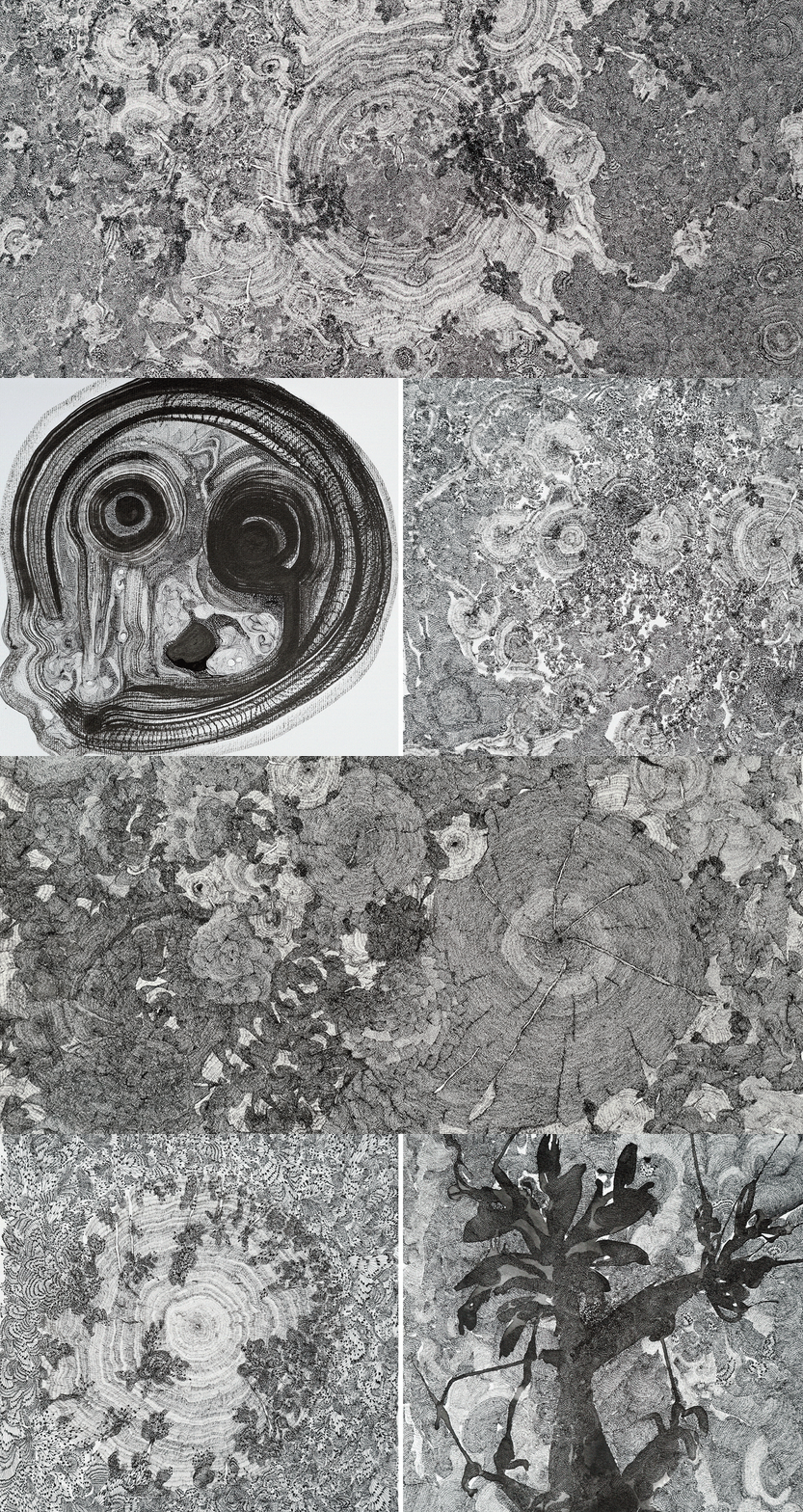
Enrico Pelissero – I want the viewer to pause and ponder. He is a writer and expert in various expressive techniques, he believes in an art capable of conveying messages and prompting reflection. His works are sometimes meticulous and rich in detail, like articulated thoughts; other times, instinctive, impulsive like gestures.

What do you describe in your artwork?

First of all, let me start by saying that I have never focused on a specific technique or type of work, as I am dedicated to both drawing and sculpture. What matters to me is addressing a topic, a theme that I want to examine and talk about because I believe it is necessary. I am convinced that through art – any form of art, be it a painting or a poem – it is possible to leave something behind or even transcend, go beyond. That’s why I’m not tied to techniques or materials. It all depends on what I want to say at that moment, and based on this, I choose how to express myself.

Do you primarily aim to convey a message through your artwork?

Often yes, often they are real “topics” that I like to address. But just as often, I find myself drawing because I feel the need to do so. In this case, I draw for myself and not to communicate with others or leave something behind. Drawing in this way relaxes me, and so I fill pages and pages with dense lines and shapes.

However, everything I do serves me to attract attention. I don’t know how this can be interpreted from a psychoanalytic point of view, but it’s something that drives me from the unconscious: everything is aimed at the viewer, because I like them to stop, observe, and think.

What do you draw inspiration from?

I draw inspiration from everything around me, from the forms that already exist in nature, which I use to create landscapes. These landscapes may seem almost alien, but they are actually very concrete. Sometimes I draw inspiration from the microcosm, from bacteria, from what is invisible because it is microscopic. In short, I have a blank page in front of me, I feel something emerging, and I strive to capture this something on paper.

One peculiar aspect of my work is that I almost always use black and white. I don’t feel comfortable with colors.

Can you tell us about one of your works to help us understand your creative process?

Let’s take the work “Un milione di segni” for example: I conceived it from the beginning as a section of forest, and gradually filled it with details. There’s a trunk here, micro-flowers there, plants creeping in and rebirthing. From that initial piece, other panels emerged that resemble each other, as if they were always echoes of that same voice. In “Pagliaccio,” instead, I wanted to create a self-portrait made up as a clown, with the fake nose, and so on. This too is a recurring theme: somewhat melancholic self-portraits, as if they represented a second personality of mine.

How do you find yourself with Cinquerosso Arte?

My collaboration has just started recently, but I can only speak positively about it. I didn’t expect someone to be so interested in my work, with the same dedication that I put into it. The results will show over time, but I felt understood and supported.

Read the article on Giulia Gray!

opere miste della mostra

An exhibition for the two-year anniversary of Cinquerosso Arte

It’s been two years since the launch of Cinquerosso Arte, and what better way to celebrate this milestone than by showcasing so much beauty? On Saturday, May 4th, 2024, from 5:00 pm to 10:00 pm, at Via Remorsella 5/2 in Bologna, a curated selection of unique pieces will be on display.

It’s an opportunity to admire and acquire artworks by emerging talents in the contemporary art scene. This celebration looks ahead to the future. Honoring a venture that, though still young, has already made a long way.

Over the past two years, cinquerossoarte.com has grown and now boasts approximately 50 artists who enrich a vast and eclectic online catalog with their creations. Additionally, Cinquerosso Arte has gained recognition by participating both as an exhibitor and as a curator of site-specific installations at some of the most important fairs dedicated to art, design, and hospitality. From Maison&Object in Paris to the White Night at Arte Fiera in Bologna, from Hospitality in Riva del Garda to the SIA – International Hospitality Exhibition in Rimini. Cinquerosso Arte has made its mark. At the latter event, Cinquerosso Arte was given a place of honor, a position confirmed for the 2024 edition: once again this year, it will return with a magnificent artistic installation in the pool area of the exhibition complex.

Above all Cinquerosso Arte caters specifically to the world of interior design with its consulting service for architects and designers, particularly focusing on hotels, cruise ships, designer restaurants, and private residences. Over time, the cinquerossoarte.com website has been enhanced with new navigation tools. It is now possible, through the Style Guide, to filter artworks according to various furniture styles: Minimal, Ethnic, Country, Neoclassic, Contemporary, etc. Although obtaining a selection in line with furnishing needs. Furthermore, it is possible to filter artworks by subject and by different colors and tones.

The range of options available to those who decide to purchase artwork has also expanded: in addition to the certified Fine Art print of the highest quality, which perfectly reproduces the original, the option to purchase digital print posters at an even more affordable price has been added. Even so a major innovation in recent months is the option of Wall Art in large format, for decorating entire walls or ceilings. For some artworks, it is also possible to purchase a usage license to print independently. In addition from unique pieces to reproductions in any format, Cinquerosso Arte is always by the side of professionals in search of beauty. See you at the exhibition on May 4th!

Read the article on Giulia Gray!

gatti acquerello colori nude

Giulia Gray – Evolution through small things

Evolution throught small things, started after years in the fashion industry.Therefore Giulia Gray shifted her focus to art, delving into the human experience through her work. Her art is a blend of instinct and contemplation, where emotions and study intertwine with impulses and reason.

Giulia, tell us about yourself.

I’ve always been painting and taking photographs, ever since I was a child, painting with oil on canvas.

Growing up, my two passions were art and fashion. Opting to study and work in fashion allowed me to keep art in a more ‘untouched’ realm. After attending fashion school in Florence and Polimoda, I joined La Perla in Bologna as a stylist. For twenty years, I pursued a successful career in design until I rediscovered my love for painting. In 2021, I made the leap to fully dedicate myself to art, and it’s been rewarding. Despite being new to this field, I’ve had positive responses: selling pieces, engaging with critics and galleries. It’s a new journey, but I feel I’m on the right path.

How do you create your art?

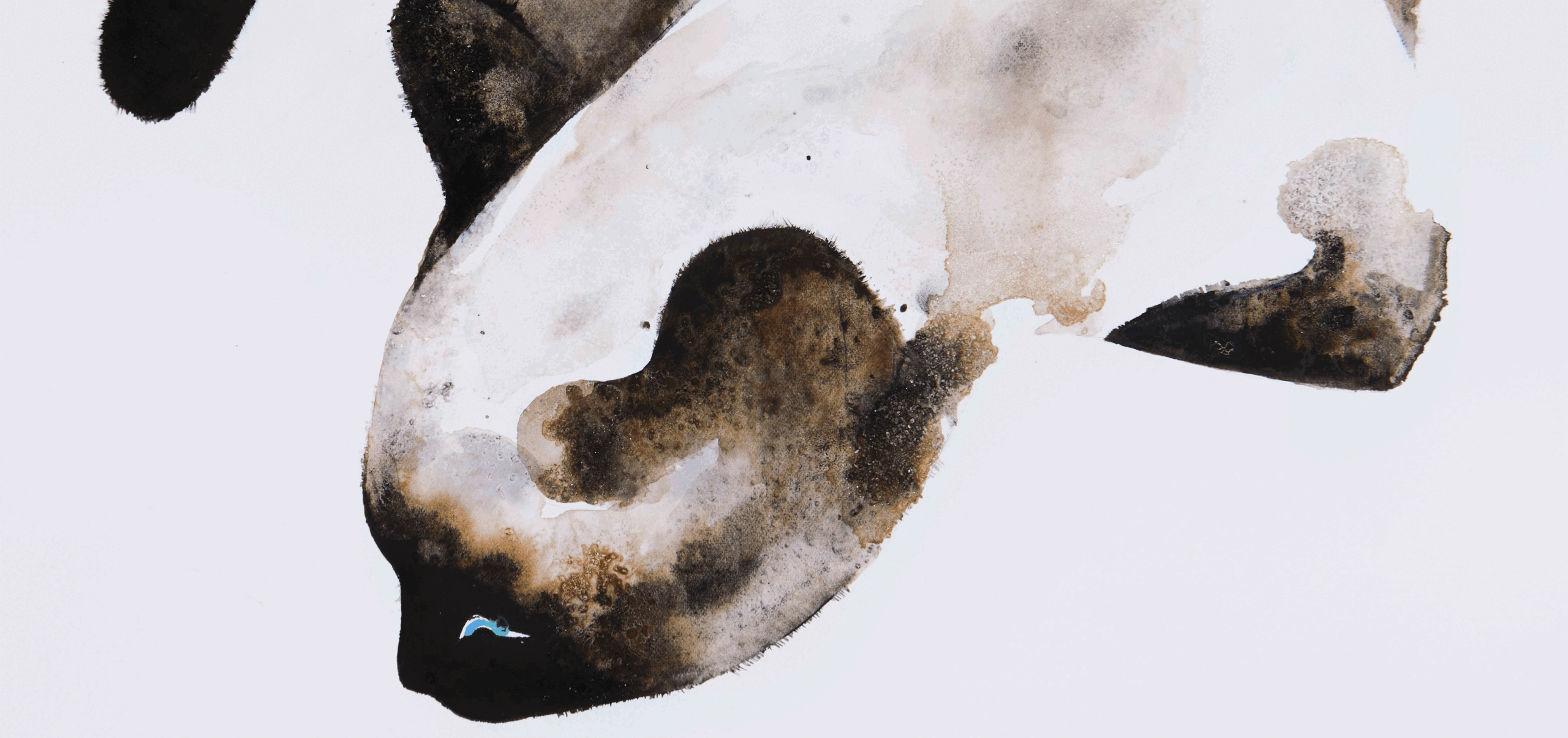
It depends. Among the artworks I proposed to Cinquerosso Arte, there are, for example, some studies featuring my cat, Spuma. When I started painting again, I wanted to develop new techniques using different materials: I mix ink and watercolor, use salt and other products to achieve particular reactions. Spuma is a muse that I always have around, since I paint at home, in my studio. His portraits essentially come from the opportunity to have a subject always available for poses. Furthermore, he is very suitable for what I want to do, also thanks to his colors.

In other artworks, some have an abstract essence.

Yes, all of a sudden after the initial period, I started doing a completely different type of work. Something much more introspective about personal growth and the general evolution of human beings. It’s quite a challenging research, which indeed leans towards abstraction. Furthermore, I don’t work olny as a painter, because I’m also interested in photography and video art, but the theme remains the same: exploring the everyday, understanding how human evolution stems from the simplest things, the smallest ones. I focus a lot on the context of home and intimacy, everything that is very intimate and daily, which we usually don’t observe because it seems mundane. Like a cat, precisely.

How much of your work is rational and how much is instinctive?

Basically, my painting is a spontaneous, instinctive expression that stems from personal work, meditation, and therapy. It reflects my experiences, emotions, and the broader spectrum of human existence. However, I aim for it to be relatable and open to interpretation, allowing each viewer to make it their own. The works are designed to be modular and customizable, creating something unique and evolving.

How are you finding Cinquerosso Arte?

Great. It seems like a very professional organization, and everyone is very friendly. It’s an exciting project that I feel enthusiastic about. I hope it continues, and for now, the impressions are very positive.

Read the article on Owen Gent!

paesaggo opere donna verde

Owen Gent- I love seeing my works come to life in new ways

Owen Gent:”I love seeing my works come to life in new ways”. He is an Illustrator for publishing and communication, and he impresses with his ability to condense complex stories and concepts into an image of rare poetry.

Owen, tell us your story. How did you get into art?

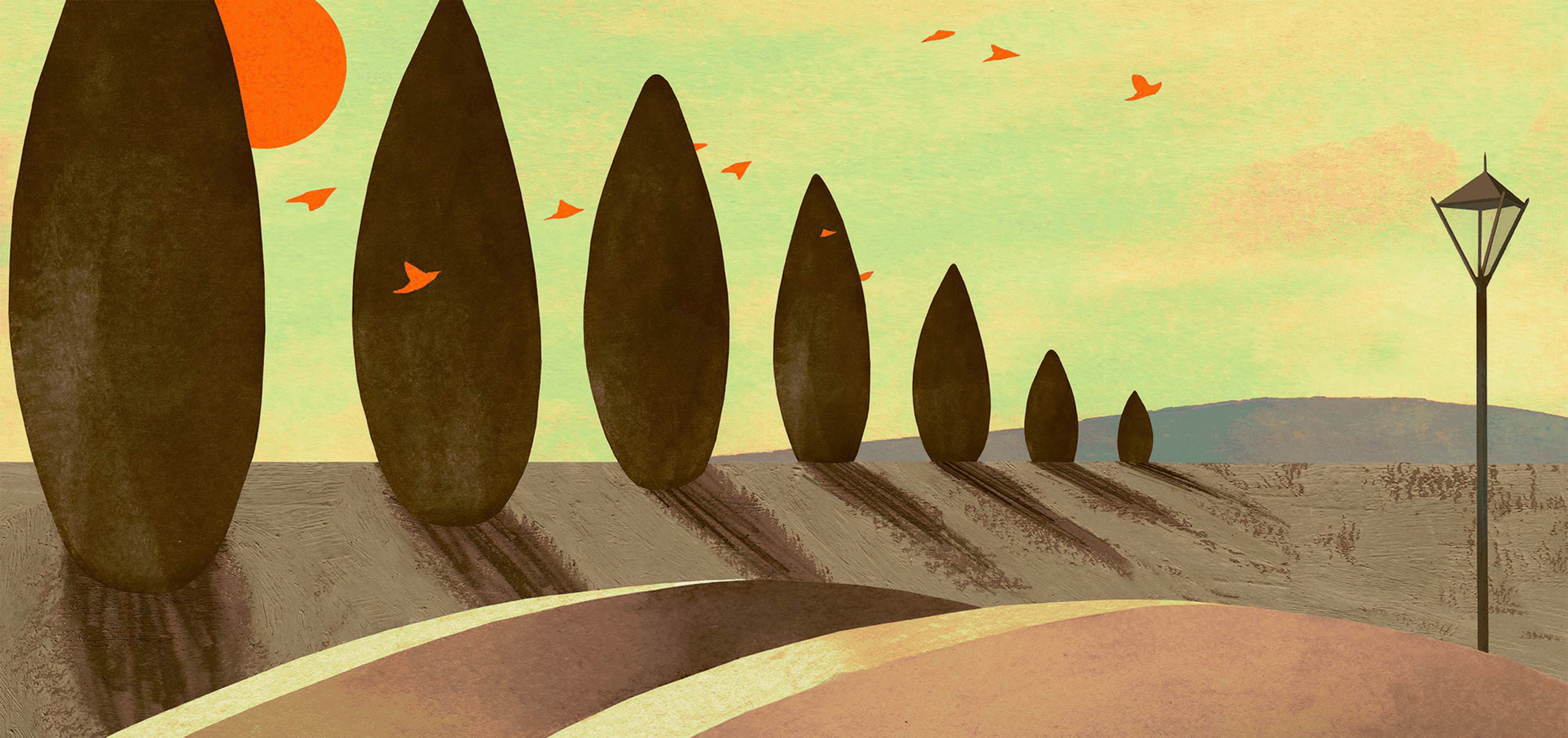
I’ve always drawn and painted. I don’t remember when I started, but my career formally began when I started studying illustration at Falmouth University in England. It was there that I truly began to develop my personal voice as a painter and illustrator, creating the first works that felt truly mine.

After graduating, I started painting signs, painting boats, and doing other odd jobs. After that, I found soon my way as an illustrator for publishing and advertising. At this time ,I also work on personal projects.

What inspires you?

I experiment and draw inspiration from many things; I also always look beyond the world of visual art. As a musician, I owe a lot to folk music and folk tales. Nature is also a great inspiration for me, especially when I travel to hike and swim in wonderful places.

What techniques do you prefer?

I use a combination of traditional and digital techniques. I start with pencils and watercolors, then scan the painting to manipulate the color, composition, and texture using Photoshop. Many of my textures are things I’ve found or created by hand, then transferred digitally. I have a huge library of textures, including pieces of wood, aged paper, used etching plates, and even organic materials like leaves, which I then turn into paintings.

What do you think of Cinquerosso Arte?

I believe it’s a great opportunity for my work to reach a new audience! I enjoy seeing what happens when one of my pieces is placed in a new context, as it gives them room to breathe and becomes part of their story.

Read the article on Sebastiano Sallemi!

pesci colori scuri blu opere

Mattia Perru – Between the known and the unknown

The artworks of Mattia Perru delve deep into the viewer’s mind, triggering emotions and thoughts that skim the surface of the unconscious. Meanwhile, the artist seeks the path towards extreme synthesis.

Mattia, what is art for you?

I have always approached art casually, without making it a life project. I am a mechanical engineer and work in a manufacturing company; something quite distant from painting. However, I come from a family where there was still an interest in visual art, particularly from my father. Let’s say that, up until a year ago, painting was a relaxing activity for me in my spare time. For the past year, I’ve decided to do it consistently, and I would like it to become a more structured activity.

Your works are quite deep. Is there a lot of thought behind them?

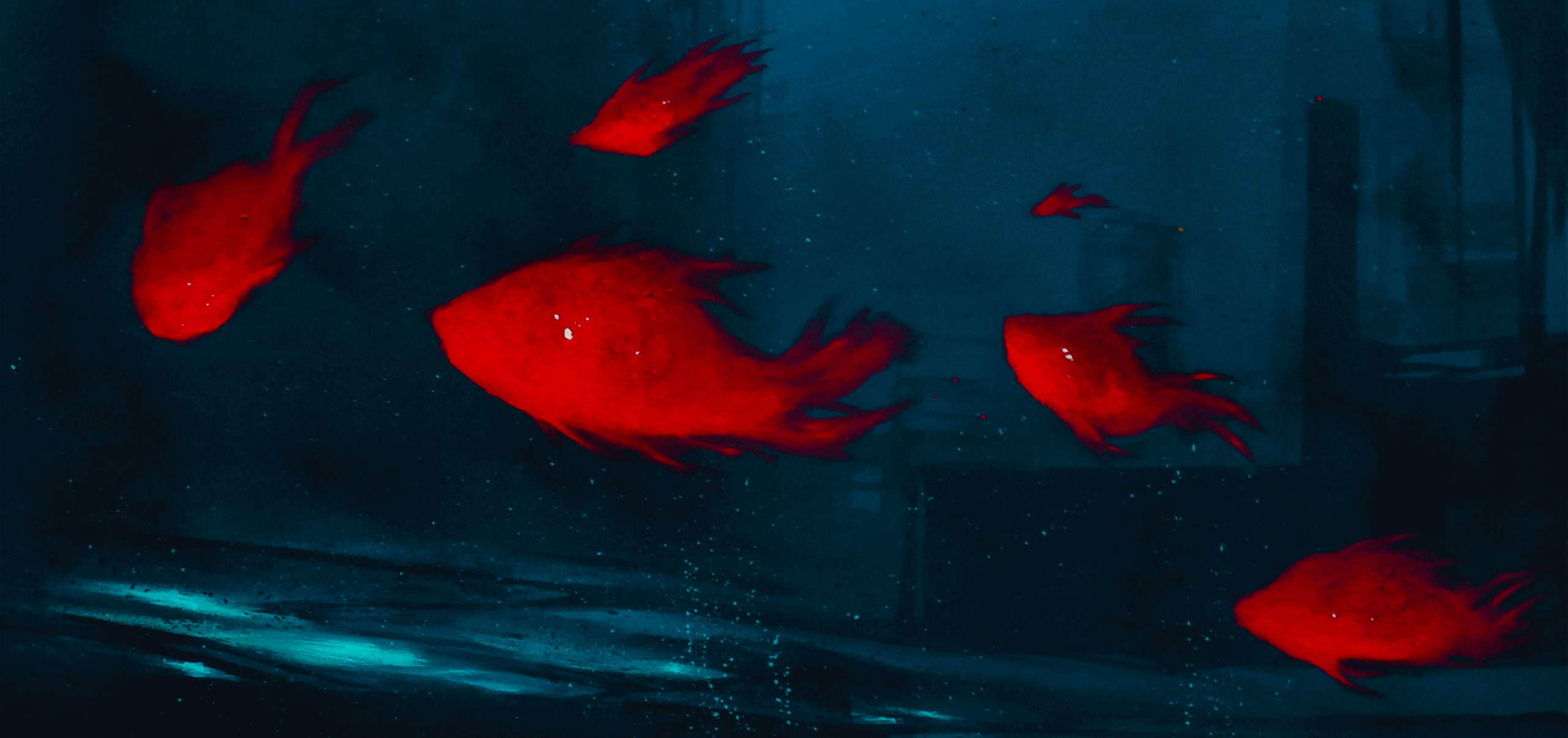
Yes, almost always there is a pre-existing planning. Before starting to paint, I immagine the scenario I want to represent. Perhaps I don’t have the subject already clear, but at least I know the atmosphere I want to create. That’s where I start. Sometimes, if I can’t immediately get to work, I take notes. Generally, in my works, there are environments and figures that are quite recognizable, but I would like to gradually move towards greater abstraction. I don’t yet have the gift of extreme synthesis, so I can’t feel comfortable in an abstract context, but I aspire to that. When I try, I find myself ending up in mannerism, and I would like to avoid that. Synthesis is not simple because it is much easier to add than to remove.

In any case, your works are quite powerful. They remind me of the masterpieces of surrealism.

First of all, thank you. Indeed, I love Magritte a lot, and in general, I appreciate the intimacy of certain atmospheres. As I mentioned, in my artworks, there are recognizable figures because I enjoy the realism of detail, but I’m not interested in the realism of the situation, in the pure and simple reproduction of reality. I’m interested in the realistically detailed decontextualized. I like creating atmospheres that reconcile introspection. I tend, for example, towards dark tones, and it comes instinctively to me to create artworks with twilight and nighttime settings. Perhaps because those are the hours when there is more tranquility, when interferences diminish, and it’s easier to think.

What would you like people to feel when they stand in front of one of your works?

I would like them to experience a sense of familiarity and, at the same time, estrangement. I want them to see something that feels like they know but can’t fully understand, like when trying to recall a dream. I sometimes come across works where there isn’t a specific detail that strikes me, there isn’t a more or less interesting situation, but there is a sense of disorientation: it feels like recognizing something familiar that I have forgotten. I really like that feeling, and I would like people to experience it in front of my works. I want them to feel touched in the unconscious.

How do you find working with Cinquerosso Arte?

I like it because everything is managed in a very professional and well-crafted manner, including the presentations on the website. Unfortunately, I couldn’t attend the anniversary reunion because I was abroad, but I hope there will be other opportunities.

Discover our B2B service!

T O P
SHARE

E-SHOP

FOR ART LOVERS
Buy unique pieces, Fine Art prints and posters

GO TO E-SHOP

B2B

FOR ARCHITECTS AND DESIGNERS
Choose the perfect artwork for your project or ask for Art Advisory

GO TO B2B SITE
X

Sign up for our newsletter

Sign up for our newsletter and receive a 10% discount on your first order. Stay up to date and get all the news on Cinquerosso arte