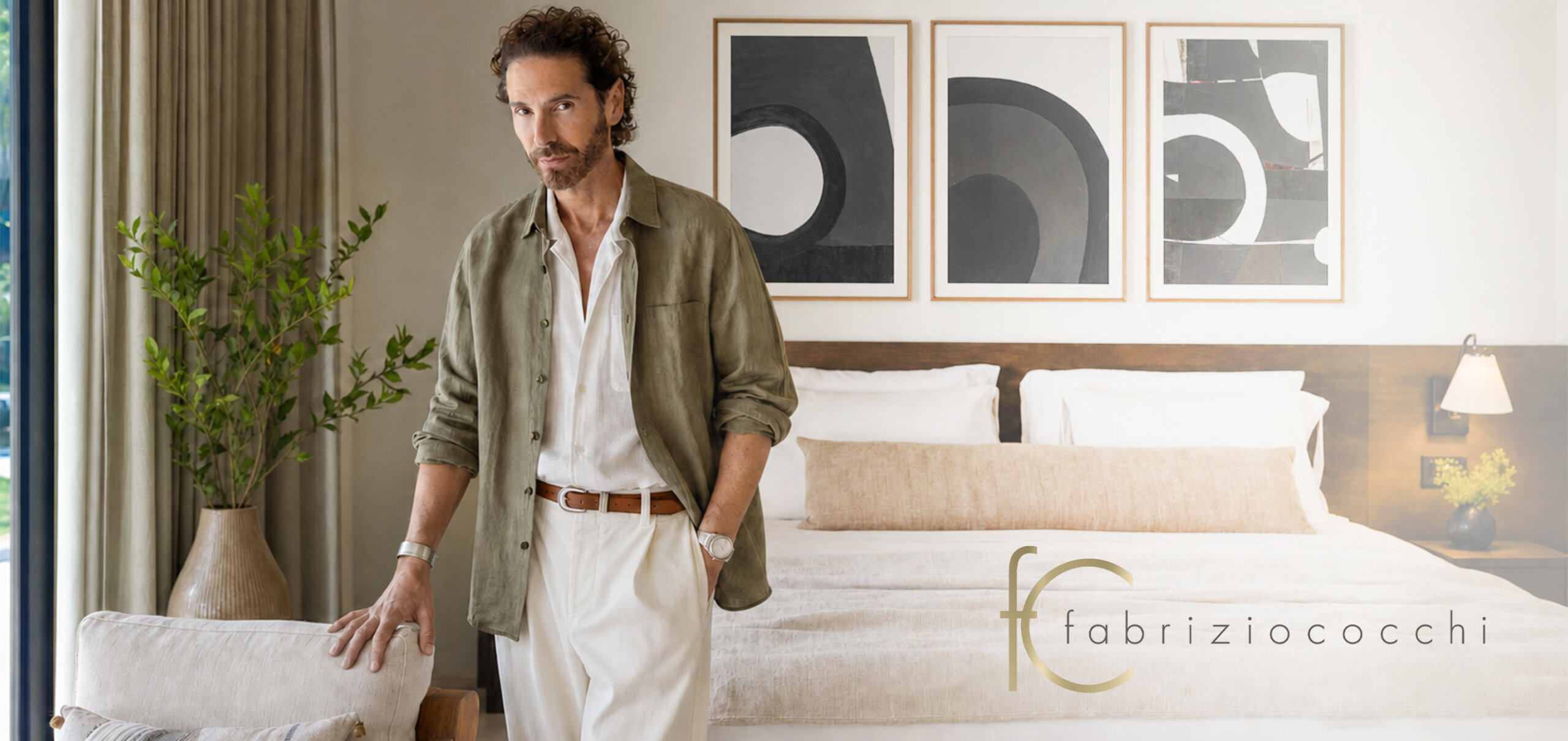
Starting with floral compositions and evolving towards interiors conceived as harmonious compositions of furniture, objects and artworks, Fabrizio Cocchi tells us about his approach to interior design, guided by one defining principle: “unique.”
Fabrizio, your professional journey is a rather distinctive one. How did it begin, and how has it evolved to where you are today?
I started many years ago with a rather unconventional flower shop: a space without a shop window, tucked away inside an old courtyard. Alongside the flowers, I also sold home accessories and small furnishings, as I had always been interested in decoration. Over time, interiors became increasingly central to what I was doing.
After a few years, I decided to hand the business over to my partner and move to New York, where I worked at Takashimaya, the Japanese concept store on Fifth Avenue. It was a fundamental experience, allowing me to engage with an international vision of design.
When I returned to Italy, I opened Camera con vista with a few partners, a project that brought together contemporary furniture, antiques and mid-century design. Even then, I was already interested in creating one-of-a-kind pieces and bespoke furniture.
I later decided to set up on my own, and from that point onwards my studio gradually evolved into what it is today: a showroom made up of three spaces, which I enjoy changing periodically, following different sources of inspiration. Sometimes, for example, the setting is more contemporary; at other times, I mix ethnic elements with vintage design pieces.
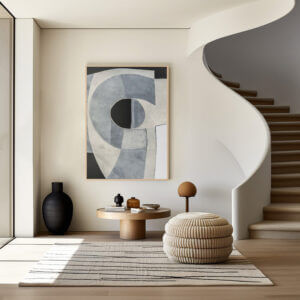
In every case, they are fully conceived environments, filled with objects, lamps, books, artworks and details. I like people who walk in to be able to immediately imagine a home that is lived in, rather than simply seeing a display of products.
What philosophy guides your work?
I never start with a catalogue. The first thing I do is understand the person in front of me. I spend a great deal of time listening to the client, understanding how they live in their home, their habits and their desires — including the things they may find difficult to put into words. A home is not a showroom: it is the place you return to every day, and it should be a place where you feel good.
That is why I prefer to approach each interior like a bespoke suit. I design sofas around the needs of the people who will use them, considering the height of the backrests, the type of upholstery, the fabrics, right down to the details of the table setting and accessories. I work closely with craftspeople and upholsterers to create one-of-a-kind pieces, tailored to the people who will live with them.
Its’ a more complex process than simply selling a brand, but the result is a home that truly reflects the person who lives in it.
What role does art play within the home, according to this philosophy?
For me, art is not simply a financial investment. It is something we live with every day, and it should evoke emotions. A work of art should engage in dialogue with its surroundings and contribute to the overall harmony of the space. If I were to buy a work simply because the market considers it important, I would probably keep it in a bank vault rather than in my living room.
Sometimes I am called in when a home is already furnished but something is missing. That is where art, colour and accessories come into play. A painting can become the disruptive element in an otherwise uniform space, or it can be the element that brings the entire project together.
I also believe it is important to give space to emerging artists: the value of a artwork does not necessarily correspond to its price. A piece by a young artist can be far more moving than a very expensive work that simply does not belong in that particular home.
You also work in the hospitality sector. How does the relationship between interior design and art change when designing a hotel?
The approach is different because considerations of scalability and budget come into play. In a hotel, art remains essential: a room without artwork on the walls can easily feel cold and impersonal. But you also have to deal with significant numbers, as a project may involve dozens of rooms.
That is why lithographs, editions or high-quality prints are often a good solution. They allow you to maintain a strong aesthetic identity without taking on unsustainable costs. The same applies to showrooms and temporary installations. Even when I worked with companies such as Cassina on photographic sets, artwork was always a central part of the setting. A home — whether real or created for an advertising campaign — never truly feels lived-in without art.
That is why I think Cinquerosso Arte’s offering is so interesting, and I believe it will become increasingly relevant in the future. There are many situations where it is important to have high-quality artwork without having to invest unrealistic amounts of money.